Category: PSS Insights

  • GCC vs Outsourcing in 2025: Which Model Delivers Sustainable Value?

    The modern C-suite faces a fundamental challenge: how to scale internationally without sacrificing control or efficiency. In an era of global talent shortages, rising compliance demands, and relentless pressure to optimize costs, global enterprises are rethinking their operational models. This strategic re-evaluation often leads to two dominant approaches: establishing a Global Capability Centre (GCC) or leveraging third-party outsourcing.

    This in-depth guide examines both models through a strategic lens, with a focus on India and the MENA region. India is an established powerhouse with a deep talent pool, while the MENA region, particularly the UAE, offers strategic proximity to Europe and a business-friendly environment.

    Our core premise is that while both GCCs and outsourcing offer distinct benefits, the right choice for your business depends on a careful analysis of control, cost, scalability, and compliance.

    What is a Global Capability Centre (GCC)?

    A GCC is a captive unit fully owned and operated by a multinational enterprise in a foreign country. Unlike an outsourced operation, the GCC is a direct extension of the parent company, fostering a shared culture and long-term strategic alignment.

    Benefits of GCCs:

    • Complete Control – Ownership of operations, data, and processes. Crucial for regulated sectors.
    • Long-Term Cost Savings – Despite higher upfront costs, GCCs can reduce operating expenses by 35–50% over time.
    • Strategic Integration – Today’s GCCs serve as AI-first hubs, R&D centres, and Centres of Excellence (CoEs), delivering innovation-not just support.

    💡 How PSS Consulting helps: We guide enterprises through India and MENA GCC setup, from market entry and compliance to assembling expert teams in Tier-2/3 cities, where costs are 25–30% lower.

    What is Outsourcing?

    Outsourcing involves delegating business functions to a third-party vendor. The vendor manages operations, talent, and delivery under contract.

    Benefits of outsourcing:

    • Lower Upfront Costs – Minimal capital expenditure, preserving cash flow.
    • Speed-to-Market – Rapid scaling with vendor infrastructure and teams.
    • Flexibility – Easy to exit or shift across vendors/geographies.

    Limitation: Dependency on vendors reduces control and raises risks around IP and data security.

    💡 How PSS Consulting helps: We operate as more than a vendor. Our on-demand talent model provides vetted specialists, free replacements, and flexible contracts—delivering outsourcing’s agility without the usual risks.

    Key Differences Between GCC vs Outsourcing (2025)

    Feature

    Global Capability Center (GCC) – Captive Model

    Outsourcing – Third-Party Model

    Ownership & Control

    Full authority over operations, data, and compliance.

    Less control as authority rests with the vendor.

    Strategic Role

    Can evolve into AI/R&D hubs and Centers of Excellence.

    Primarily transactional; focused on task execution.

    Culture & Alignment

    Unified organizational culture and compliance structure.

    Distinct vendor culture; potential for misalignment.

    Cost Dynamics

    Higher initial costs, but 35–50% savings over time.

    Lower upfront costs, suitable for testing markets.

    Flexibility

    Less flexible due to direct ownership and investment.

    Highly flexible and scalable based on business needs.

    Expertise

    Requires in-house development of expertise.

    Immediate access to the vendor’s specialized knowledge.

    Risk

    You bear all operational risks (e.g., staffing, infrastructure).

    The vendor absorbs a portion of operational risks.

    Location

    Strategic choice for lower operating costs in India/MENA Tier-2/3 cities.

    The vendor chooses the location for service delivery.

    Cost Savings Analysis – India & MENA 2025

    India: Savings of 40–70% vs onshore. Tier-2 hubs unlock further arbitrage.

    MENA (UAE, Saudi): Higher ops cost, but proximity to Europe, tax incentives, and compliance strength.

    Hybrid Trend: Core functions in UAE GCC + scale operations in India GCC = rising best practice.

    Decision Framework – Which Model Fits Your Business?

    High Control Low Control
    High Speed BOT/Assisted GCC – Rapid setup with long-term ownership. Outsourcing – Best for SMBs, non-core functions.
    High Budget GCC – Ideal for R&D, regulated industries, sustainable scale. Hybrid – GCC for strategy + outsourcing for efficiency.

    Stage Guidance:

    • Startups/SMBs: Outsourcing for fast, low-cost scaling.
    • Scaling past 300 FTE: GCC in India for sustainable growth.
    • Regulated industries: GCC in UAE/Saudi for compliance.
    • Budget < $2M: Outsourcing as a safe entry strategy.

    The Future – Hybrid & BOT Models

    • BOT (Build-Operate-Transfer) – A bridge between outsourcing and GCC.
    • Dual-shore – India for scale, UAE for leadership and compliance.
    • Assisted GCCs – Vendor aids setup, client retains full control from Day 1.

    Choosing between a GCC, outsourcing, or a hybrid model isn’t about a single “right” answer – it’s about matching the model to your company’s stage, budget, and compliance needs.

    • GCCs deliver unmatched control, compliance assurance, and long-term strategic value.
    • Outsourcing offers speed, flexibility, and lower upfront costs for rapid scaling.
    • Hybrid strategies combine the best of both, giving enterprises resilience and cost efficiency.

    At PSS Consulting, we don’t leave you guessing. We partner with you to analyze your priorities – control, speed, scale, budget -and translate them into a tailored operating model. From outsourcing pilots to BOT transitions and full GCC builds, our AI-driven insights, compliance expertise, and global talent network ensure you execute with confidence.

    Next step: Download our Decision Tree PDF – GCC vs Outsourcing for a personalized roadmap to the model that will maximize value for your business.


    PSS Business Model Quiz (Inline Results)


    Find Your Optimal Business Model

    Answer 6 questions to get a tailored recommendation with a 30-day action plan.


    Please answer all questions.


  • Why Smart Founders Are Rethinking Their Tech Stacks (And How to Choose Without Burning Cash) in 2025

    Tech Stack Decisions: Avoiding Costly Mistakes Before They Happen

    Most founders still approach tech stack decisions with outdated assumptions. The choice between no-code and custom code is not merely technical; it is a strategic business decision that impacts a startup’s trajectory, budget, and long-term viability. When made incorrectly, this decision can cause rising complexities, hidden costs, and major issues down the line.

    Many entrepreneurs focus solely on the initial development cost, which can be misleading. No-code platforms often present a low upfront investment, with development costs starting as low as $1,500 compared to $20,000 to over $100,000 for custom coding. However, this initial saving can be the “tip of the iceberg.” Hidden expenses-scaling fees, overage charges for API calls or workload units, and the cost of integrating numerous third-party services-can quickly accumulate. One retail client reported spending an average of 20 hours per person on training for a new no-code platform-an invisible onboarding cost. These unforeseen costs can increase the total cost of ownership (TCO) by 30-50% over five years, eroding initial savings.

    The choice also presents a critical trade-off between rapid strategic agility and accumulating technical debt. No-code platforms promise rapid prototyping, allowing founders to launch MVPs in weeks rather than months. But as the application grows in complexity, no-code solutions often lead to customization limits and scalability issues. On the other hand, custom code, while slower and more expensive upfront, builds a robust, scalable foundation for evolving business needs.

    WHY FOUNDERS ARE RETHINKING THEIR TECH STACKS

    In today’s business climate, sticking to outdated development paths is no longer just inefficient – it’s risky. Founders aren’t just reacting to trends; they’re responding to three powerful shifts:

    • Rising operational costs: What looked affordable upfront now carries long-term baggage – from license fees to developer overhead.

    • Speed vs. Scalability dilemmas: No-code platforms promise quick MVPs but often struggle when complexity or performance is needed.

    • Vibe Coding distractions: The trend of jumping into tools that “feel cool” without strategic fit leads many teams to build flashy products that don’t scale.

    Startups that once relied on no-code for speed are now facing limits when it comes to customization, compliance, or cross-platform expansion. Meanwhile, full-code projects that lacked early guardrails are drowning in technical debt.

    The Two Most Overlooked Strategic Levers

    Most tech stack debates stop at cost vs control. But smart founders are learning to pull deeper strategic levers:

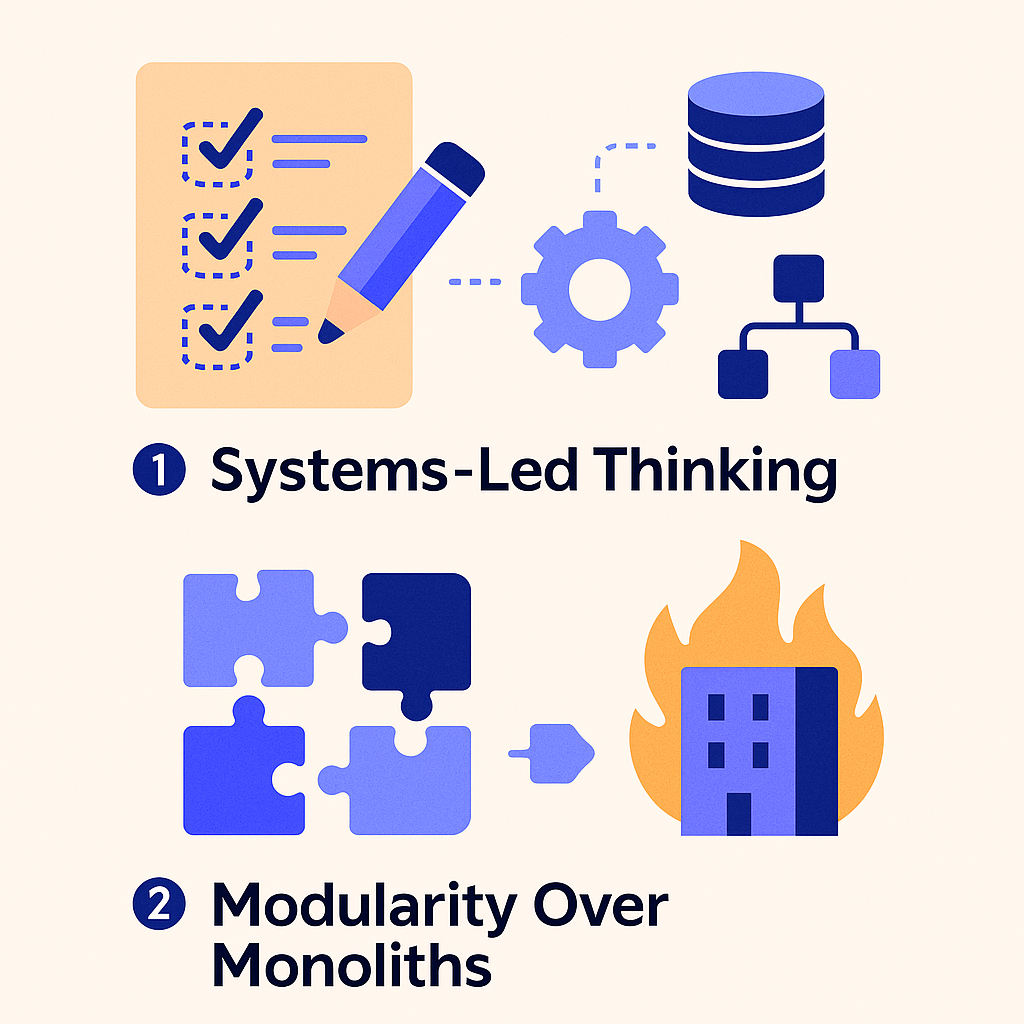
    1. Systems-Led Thinking (Not Just Tool-Led)

    Instead of chasing trending tools or “vibe coding” platforms, high-leverage teams define the system first-how data flows, how teams interact, and how scale will be managed. The tools come after that clarity.

    Example: A retail platform grew 3x faster by mapping user journeys before selecting tools-avoiding 4 replatforming cycles.

    1. Modularity Over Monoliths

    Choosing tech that’s plug-and-play (think: composable architecture) lets you pivot faster. You’re not locked into one massive codebase or platform. You can test and replace parts without burning the whole thing down.

    Pro Tip: PSS Consulting helps teams structure this via “Strategic Stack Mapping” before development even begins-reducing tech debt by up to 40% in year one.

    What Most Businesses Get Wrong

    Mistaking UI for Strategy: Teams fall for polished interfaces and “quick wins,” without clarifying core workflows or scalability needs. Result? Rebuilds within 12–18 months.

    Underestimating Total Cost of Ownership (TCO): What looks cheap at launch balloons over time with API overages, external integrations, and team inefficiencies.

    Ignoring Ops & Compliance Early: No-code tools may launch MVPs fast, but as teams scale, they hit walls in security, cross-platform compatibility, and backend oversight.

    How a Hybrid Approach Helps (Without Sacrificing Agility)

    Start lean, then scale smart. Use no-code for MVP validation and early feedback. When traction hits, plan the switch to custom development for scale, security, and long-term growth. This hybrid strategy balances speed, cost, and future control.

    What the Leaders Are Doing:

    • Comet validated with Bubble, raised $2M.

    • Teal built with Bubble + Airtable, hit $1M ARR.

    • Stripe & OpenAI custom-built their IP from day one-now infrastructure players.

    Founders who treat tech stacks as tools – not as the strategy itself – build faster, pivot smarter, and scale more sustainably.

    If you’re still choosing between platforms without mapping your system, you’re skipping the most critical step.

    PSS Consulting helps businesses architect scalable, low-debt systems from Day 1 – with strategic stack mapping, vetted dev teams, and modular thinking baked in.

    Ready to rethink your stack with clarity and control?

    Try the Tech Stack Navigator – a free interactive tool that helps you decide between no-code, custom code, or hybrid based on your product complexity, budget, and future goals.

    🧩 Tech Stack Navigator

    Answer 6 quick questions to find your ideal tech stack strategy.


    Feeling Stuck? We Can Help.

  • Why Smart Founders Are Redesigning Their Global Supply Chains (And How to Do It Without Overstretching Your Team)

    Why Smart Founders Are Redesigning Their Supply Chains in 2025 [+ Free Sourcing ROI Calculator]

    Rethink Your Supply Chain Before It Costs You

    Many founders and operational leaders are still relying on sourcing strategies developed in 2015, operating under assumptions no longer valid in today’s fundamentally transformed 2025 economy. Traditional sourcing models focused on single-region dependencies have become increasingly unsustainable due to escalating costs, unpredictable delivery timelines, and geopolitical instability. Recent tariff hikes have significantly increased cost burdens, making previously profitable products unviable.

    In the first half of 2024 alone, supply chain disruptions surged by 30%, affecting 76% of European businesses through events such as trade wars, extreme weather, and cyber incidents. The unpredictability of these disruptions makes traditional budgeting and pricing extremely challenging, requiring a strategic pivot from reactive cost management to proactive cost redesign.

    Why Founders Are Moving Production-and Fast

    Relocating production is no longer solely about cutting costs; it’s driven by the urgent need for resilience, predictability, and geopolitical risk mitigation. Several key factors are compelling this shift:

    Labor Cost Spikes: Manufacturing wages in China have doubled over the last decade, eroding traditional cost advantages.
    Geopolitical Volatility: Increasing trade restrictions and non-tariff barriers make certain sourcing locations risky.
    Supply Fragility: Documented disruptions have surged significantly, with limited visibility into deeper-tier supplier networks exacerbating vulnerabilities.

    Founders are increasingly shifting production to India, Vietnam, Mexico, and the UAE, each offering unique strategic advantages such as cost-efficiency, proximity, or favorable trade agreements.

    Country/Region Labor Cost (vs US) Key Advantage Considerations/Risks
    🇺🇸 USA Highest (baseline) Proximity, strong IP, fast delivery High labor & ops costs, poor scalability
    🇨🇳 China 1/3 to 1/4 of US; 100%+ rise High volume, mature supply chains Tariffs (125–145%), IP risk, compliance complexity
    🇻🇳 Vietnam 50% less than China; <1/10 US Competitive, improving English, tech ecosystem Infra gaps, smaller talent pool
    🇮🇳 India $15–25/hr (Jr), $45–65 (Sr) Massive talent pool (1.5M engineers/year) Time zone, provider variance
    🇲🇽 Mexico 1/8 of US Nearshoring, USMCA, shipping advantage USMCA 2026 review risk
    🇵🇭 Philippines $12–22/hr (Jr), $32–45 (Sr) English fluency, Western culture fit Lacks deep specialization
    🇦🇪 UAE Not a labor base Re-export hub, tariff minimization Logistics only, not primary production location

    Sources: Gembah, TradeVerifyd, World Economic Forum, PlusTalent 2025 Reports

    Two Strategic Levers Most Founders Overlook

    Two Strategic Levers Most Founders Overlook

    • Production Arbitrage: Strategically relocating manufacturing or assembly operations to optimize costs and resilience, transforming the approach from purely cost-driven to a comprehensive risk mitigation strategy.
    • Service Arbitrage: Utilizing remote teams for critical operational functions such as compliance, QA, vendor management, and logistics, significantly reducing overhead while ensuring control and scalability.

    Example: Global sportswear leader PUMA implemented a modern vendor management and service arbitrage model to tackle growing compliance and data security threats. They:

    Centralized vendor onboarding and continuous risk assessments across hundreds of suppliers globally

    Used a two-tiered vendor governance model: automated compliance checks backed by regional remote teams in Asia and the Middle East to oversee audits and risk .

    Result? Established a risk-aware culture, reduced onboarding cycle times, and effectively managed information security-without bloating internal staff

    What Most Founders Get Wrong

    Common pitfalls include:

    • Engaging unvetted vendors, leading to quality and compliance issues
    • Overestimating internal team capabilities, causing project overload
    • Failing to conduct accurate landed-cost simulations, leading to unexpected expenses

    Effective execution requires a knowledgeable partner who understands the complexities of international sourcing and risk management.

    How PSS Consulting Helps (Without Adding Overhead)

    PSS Consulting bridges the gap between strategic intent and execution, offering:

    • Strategic Sourcing Advisory: Tailored advice for optimal sourcing locations and strategies
    • Pre-Vetted Global Vendor Network: Immediate access to reliable and compliant suppliers
    • Dedicated Remote Teams: Experienced professionals managing operations, compliance, and logistics
    • Landed Cost Simulations: Comprehensive modeling to provide predictable costs

    What the Giants Are Doing (Real Case Snapshots)

    Apple/Foxconn: Relocated significant iPhone production to India, airlifting $2 billion in products to the US in March 2025 to circumvent substantial tariffs.

    Shein: Shifted production to Vietnam to mitigate rising tariffs and maintain competitive pricing.

    Feature Apple/Foxconn (India) Shein (Vietnam)
    Companies Apple, Foxconn Shein
    Origin/Destination China → India → United States China → Vietnam
    Primary Driver Immediate Tariff Avoidance (Tariff Arbitrage) Long-term Cost Competitiveness & Tariff Mitigation (Production Arbitrage)
    Specific Action Airlifted $2 billion worth of iPhones in March 2025 from India to US Partial production relocation from China to Vietnam
    Key Outcome/Benefit Circumvented impending tariffs, secured supply chain agility Maintained cost competitiveness, enhanced supply chain efficiency
    Strategic Implication Rapid, tactical response to policy shifts; high-stakes supply chain agility Proactive diversification; building long-term resilience into core production

    Don’t Just Cut Costs-Redesign Control

    Redesigning your supply chain isn’t merely about cost reduction. It’s about strategically reclaiming control, stabilizing margins, and reinvesting savings into growth, talent, and innovation.

    Ready to Explore?

    Take control of your manufacturing strategy today:

    Click Here


    Why Smart Founders Are Redesigning Their Supply Chains in 2025 [+ Free Sourcing ROI Calculator]


    📍 Sourcing ROI Calculator

    Find your most cost-effective, compliant, and scalable sourcing location in <40 s


    📊 Cost Benchmark Comparison

    💡 ROI Summary

    📈 Estimated ROI

    💵 Potential Savings

    ✅ Best Move

    📉 Risk Overview by Region

    🇮🇳
    India: Moderate compliance, low tariff risk
    🇻🇳
    Vietnam: Fast delivery, rising wage pressure
    🇲🇽
    Mexico: Stable US access, medium inflation volatility

  • Why Your Automation Stack Is Costing You Time, Money, and Growth

    Why Your Automation Stack Is Costing You Time, Money, and Growth

    The Tool Trap: Why Your Workflow Automation Tools Are Costing You More Than They’re Worth [+ Free Workflow Audit]

    And the framework scaling teams use to turn chaos into clarity

    Meet Alex

    A SaaS founder juggling five workflow automation tools, a small remote team, and a rapidly scaling customer base.

    Alex thought he was doing everything right:

    Zapier connected his apps. Airtable tracked projects. Notion stored SOPs. Slack, Calendly, and GDrive held the rest of his workflow together.

    But weeks in, things started breaking:

    • Automations were failing silently.
    • Tasks fell through the cracks.
    • Onboarding new team members felt like explaining spaghetti code.
    • Monthly tool bills crossed $700-and rising.

    What started as a way to save time and money became a constant loop of debugging workflows and duct-taping apps together

    Illustration of overwhelmed team struggling with automation tools and rising costs, showing $700/month in SaaS expenses.

    Sounds Familiar??

    Why Most Teams Don’t Need More Tools-They Need a Better Strategy

    If you’re relying on tools to run your business-but still feel like the bottleneck-you’re not alone.

    Most teams don’t have a tech stack problem.They have a strategy problem disguised as automation.

    Here’s how it usually plays out:

    • Automation breaks? Add another tool.
    • Workflow slows down? Add another template.
    • Team overwhelmed? Add another dashboard.

    The logic seems sound:
    “If we connect the right tools, everything should run smoothly.”

    But here’s the uncomfortable truth:
    Tools only accelerate what’s already working.
    If your process is broken, automation just scales the dysfunction.

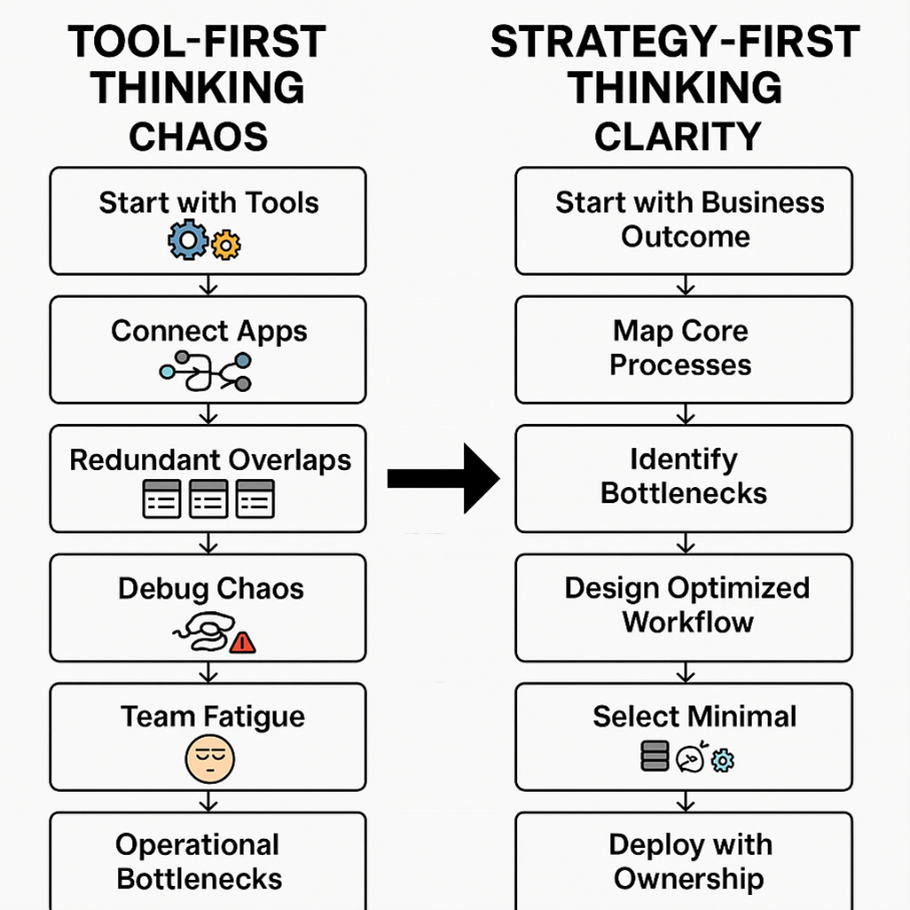
    Comparison of tool-first chaos and strategy-first clarity in business automation workflows

    Here’s what successful founders do differently

    Here’s what successful founders do differently:
    They don’t start with tools.
    They start with outcomes-and reverse-engineer the workflow.

    At PSS Consulting, we help teams shift from tool-first chaos to strategy-first clarity using this proven model:

    1. Architect the System
      Map your processes around business outcomes—not software.
      (Example: Lead gen → onboarding → delivery, designed upfront.)
    2. Diagnose Workflow Leaks
      Run our ROI Audit to expose delays, duplications, or handoff breakdowns.
      (Finally know where your operations are bleeding time.)
    3. Deploy the Engine
      Launch fast using our on-demand talent—no hiring delays, no overhead.
      (Need an Airtable engineer or Make.com expert? Delivered.)

    When strategy leads, tools follow.
    And that’s when automation becomes scalable-not stressful.

    Visual diagram illustrating PSS Consulting’s three-step Strategy-First Automation Model: Architect the system, Diagnose workflow leaks, and Deploy the engine.

    Ready to stop firefighting and finally scale with clarity?
    Take our free Workflow Bottleneck Audit to uncover where your business is leaking time and money-before investing in another tool.

    WORKFLOW EFFICIENCY AUDIT

    Rate how smoothly each area of your business operates

    1 (Needs improvement)
    5 (Works perfectly)
    When a new lead comes in, is it handled quickly and consistently?
    1
    2
    3
    4
    5
    When work passes between tools/people, is it seamless?
    1
    2
    3
    4
    5
    Can new team members contribute quickly without hand-holding?
    1
    2
    3
    4
    5
    Can you access key numbers in real-time?
    1
    2
    3
    4
    5
    Are issues fixed before they turn into crises?
    1
    2
    3
    4
    5
    Can team members figure out tasks without asking you?
    1
    2
    3
    4
    5
    Is there never confusion about who owns what?
    1
    2
    3
    4
    5
    Your Workflow Score
    0
    /
    35
    📋
    Ready to Start
    Complete all questions above to see your workflow efficiency results.

    Still Feeling the Bottlenecks?

    Your Score  Reveals gaps-but tools won’t Fix them, Strategy Will. Let’s Build yours, Together

    Click Here

  • Ready for 2025? Transform Your Business with Operational Auditing Now

    Ready for 2025? Transform Your Business with Operational Auditing Now

    As we wrap up 2024 and step into 2025, many startups and small businesses are renewing their focus on operational excellence. A well-executed operational audit can expose hidden inefficiencies, bring cross-functional teams into alignment, and prepare organizations to meet the evolving market challenges of the new year.

    1. What Is Operational Auditing?

    Operational auditing involves examining every core process—from production workflows to quality-control checks—to ensure each step is necessary and effective. Think of it as a “root-cause” analysis of your business operations, leveraging advanced tools like process mapping, real-time analytics, and predictive modeling to uncover unseen bottlenecks.

    Key Focus Areas:

    • Efficiency: Streamline processes to eliminate redundant tasks and reduce cycle times.
    • Effectiveness: Validate that each function directly supports your strategic business goals.
    • Risk Mitigation: Use data-driven risk matrices and scenario planning to anticipate and neutralize vulnerabilities.

    Picture this process like a state-of-the-art vehicle diagnostic: rather than just swapping out worn parts, you integrate sensor data, run system checks, and fine-tune every component for top performance and reliability.

    Vehicle diagnostic compared to operational auditing

    A Streamlined Auditing Framework

    Although auditing methodologies vary, a robust framework couples industry best practices with data analytics:

    1. Risk-Based Prioritization

      Concentrate your audit on high-impact areas, like critical supply chain nodes or compliance bottlenecks. This approach ensures efficient use of time and resources.

    2. Integrated Audits
      Break down departmental silos by examining how HR, finance, and production processes overlap. Identifying duplicate tasks or data gaps can reveal automation opportunities and widespread efficiency gains.
    3. Tailored Recommendations
      Every business has unique needs. Whether you’re a regional manufacturer or a SaaS startup, solutions should align with your organization’s vision, culture, and industry standards.

    Expert Insights & Practical Tools

    We utilize frameworks such as the 8 Es of Auditing—Effectiveness, Efficiency, Economy, Ethics, Environment, Equity, Engagement, and Evolution—to ensure a balanced approach. Practical audits often employ root-cause analysis, Pareto charts, and process flow modeling, providing a data-backed blueprint for sustainable improvements.

    8 E's of Auditing

    Why an Operational Audit Matters for 2025

    With 2025 set to bring continued market volatility and digital disruption, a comprehensive operational audit arms you with the agility and foresight to:

    • Navigate Uncertainties: Spot potential problems before they escalate into crises.
    • Boost Profit Margins: Slash overhead by eliminating redundant processes and redeploying resources to high-impact initiatives.
    • Foster Sustainable Growth: Align operational steps with your strategic vision, ensuring you remain both adaptive and resilient.
    Are you ready to level up your operations in 2025? Contact PSS Consulting for a complimentary consultation on how an operational audit can reshape your efficiency, cost savings, and long-term competitiveness.

    Download Your Free Operational Audit Checklist

    Take the guesswork out of the auditing process. Download our comprehensive Operational Audit Checklist

    to guide your internal review, track actionable steps, and keep your team aligned—whether you’re addressing small-scale process tweaks or a full-scale operational overhaul.

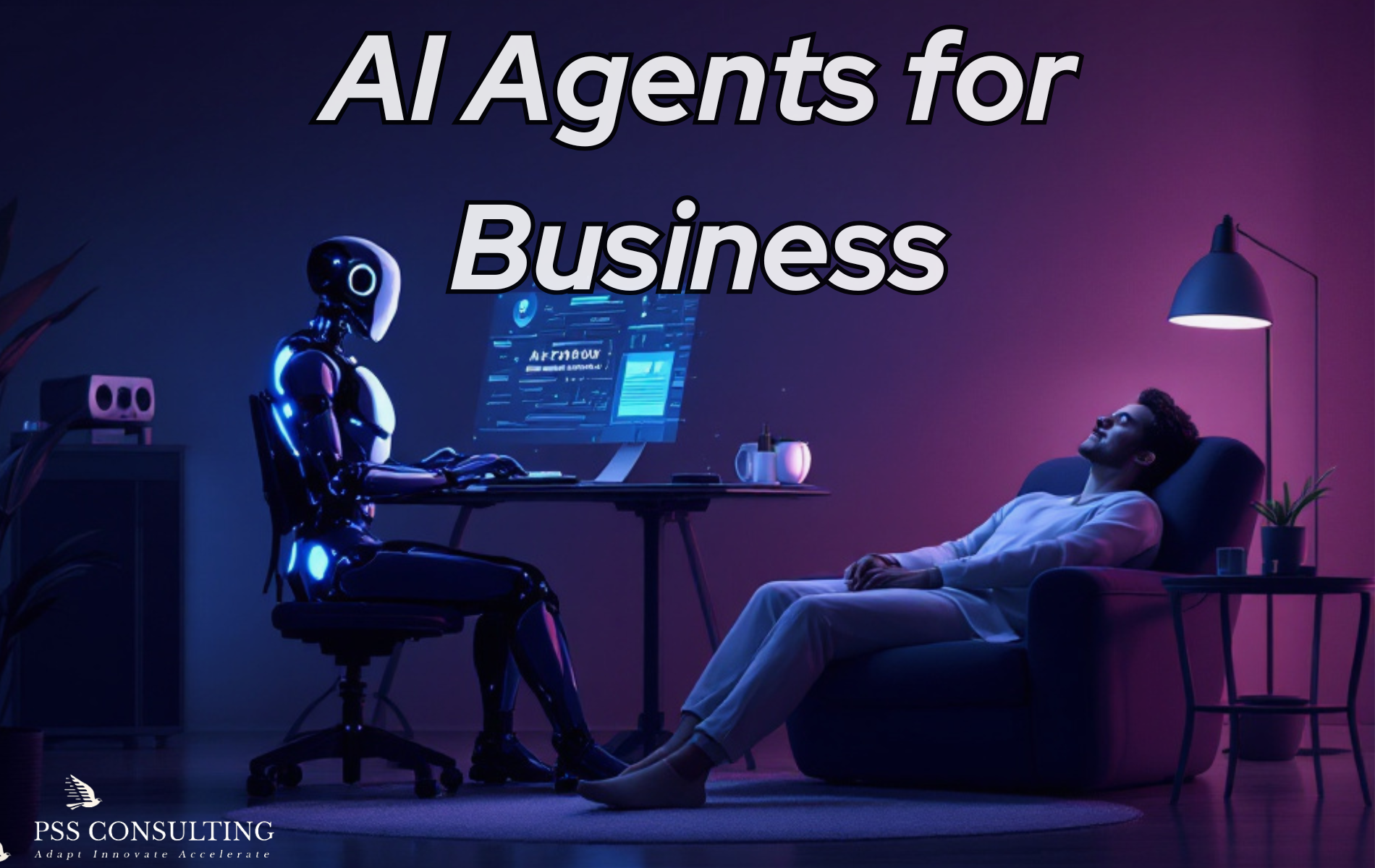
  • AI Agents for Business: Opportunities and Risks from the WEF Report

    AI Agents for Business: Opportunities and Risks from the WEF Report

    The World Economic Forum’s (WEF) recent whitepaper, “Navigating the AI Frontier,” highlights the transformative potential of AI agents across industries. These autonomous systems are revolutionizing efficiency, decision-making, and innovation while addressing critical governance and ethical challenges. Below is a summary of the most impactful takeaways.

    What Are AI Agents?

    AI agents are intelligent, autonomous systems designed to interact with their environment to achieve specific goals. They process vast amounts of data, learn from it, and execute decisions with minimal human intervention. For instance, in retail, an AI agent might analyze customer purchase histories to recommend products in real-time, while in manufacturing, it could predict equipment failures and schedule maintenance to avoid downtime. These practical applications demonstrate how AI agents are reshaping workflows, enhancing decision-making, and revolutionizing the way businesses operate.

    AI Agent explanation

    Key Benefits of AI Agents

    The World Economic Forum’s report highlights three transformative benefits of AI agents across industries:

    1) Automation & Efficiency

    AI agents streamline operations by automating repetitive and resource-intensive tasks. For instance:

    • In supply chain management, AI agents predict demand, optimize inventory, and reduce delivery delays.
    • In data analysis, they process vast datasets rapidly, providing actionable insights that would otherwise require significant human effort.
      This efficiency reduces costs, enhances productivity, and eliminates the risk of human errors in mundane tasks.

    2) Enhanced Decision-Making

    AI agents empower decision-makers by offering precise, real-time insights. Examples include:

    • Finance: AI agents detect fraud by identifying unusual patterns in transaction data, enabling real-time risk mitigation.
    • Healthcare: These systems assist in diagnostics, suggesting accurate treatment plans based on patient data, and help hospitals optimize resource allocation, such as bed management and equipment usage.
      By delivering faster, data-driven insights, AI agents improve decision quality and outcomes across industries.

    3) Improved Customer Experiences

    AI-powered tools like chatbots and recommendation engines transform customer interactions.

    • In retail and e-commerce: These systems offer personalized support and product recommendations, helping customers find what they need effortlessly.
    • In customer service: AI agents handle queries instantly, improving satisfaction and reducing response times.
      By enabling businesses to anticipate and address customer needs proactively, AI agents build loyalty and elevate the user experience

    The Three Pillars of Successful AI Agent Adoption

    Adopting AI agents effectively requires more than technology; it demands strategic foresight. The WEF report identifies three essential pillars:

    1. Strategic Planning
    Focus on high-impact areas like real-time analytics in finance or personalized customer experiences in retail. Thoughtful planning ensures measurable results.

    2. Seamless Integration
    Align AI systems with existing workflows, train teams, and conduct thorough testing. This minimizes disruptions and accelerates ROI.

    3. Ongoing Evolution
    Continuously monitor, refine, and scale AI agents to adapt to changing needs. Regular optimization ensures sustained growth and innovation.

    Emerging Trends in AI Agent Development

    The WEF report highlights several transformative trends redefining the role of AI agents in various industries:

    1. Multi-Agent Systems (MAS):
      Collaboration between AI agents is enabling them to tackle intricate challenges. For instance, in smart cities, multiple AI agents can coordinate to manage traffic flows in real-time, reducing congestion and improving urban mobility. Similarly, in decentralized logistics, these agents can optimize supply chain operations, ensuring timely deliveries and cost efficiency.

    2. Increased Autonomy:
      Advanced AI agents are evolving to independently plan and execute tasks without human intervention. This opens new possibilities in industrial automation, such as fully automated production lines, and urban development, where agents could manage energy grids or infrastructure projects efficiently.

    3. Ethical Governance:
      As adoption grows, businesses are prioritizing responsible AI usage. For example, 54% of organizations are actively creating governance frameworks to ensure AI systems remain transparent, ethical, and accountable. This includes measures like bias reduction, data privacy protocols, and clear decision-making processes to build trust with stakeholders.

    How PSS Consulting Can Help

    Adopting AI agents can be transformative, but success requires the right expertise. PSS Consulting specializes in guiding businesses through the complexities of AI adoption with tailored solutions and a network of world-class Fortune 500 consultants.

    What We Offer

    Customized Strategies: We pinpoint high-impact opportunities, from automating workflows in manufacturing to delivering personalized customer experiences in retail.
    Seamless Integration: Our team ensures AI systems integrate smoothly into existing workflows, minimizing disruptions and maximizing ROI.
    Continuous Optimization: We provide ongoing support to refine and scale AI solutions, keeping your business aligned with evolving needs.

    With access to a global network of industry-leading consultants, PSS Consulting brings unparalleled expertise and insights to help you achieve measurable, sustainable results.

    Ready to Transform Your Business?


    Contact Us for AI Solutions


    Download the WEF Report

    By partnering with PSS Consulting, you’ll gain the expertise and resources needed to turn AI potential into tangible business success.

  • Elevate Your Startup Pitch: Sequoia Capital’s Proven Template Now Available

    Elevate Your Startup Pitch: Sequoia Capital’s Proven Template Now Available

    Are you ready to impress potential investors with a winning startup pitch? The Sequoia Capital pitch deck template, a proven framework used by one of Silicon Valley’s most successful venture capital firms, is now available for free download.

    Why Choose the Sequoia Capital Pitch Deck Template?

    • Proven Success: This template has helped countless startups secure millions in funding.
    • Strategic Structure: It’s designed to highlight the key points investors are looking for.
    • Insider Insights: Learn how Sequoia Capital evaluates potential investments.

    What You’ll Get:

    • A laser-focused pitch deck structure
    • Valuable insights from a top-tier VC firm
    • A proven narrative that has impressed investors

    Download Your Free Template Today

    1. Click the button below.
    2. Enter your email address.
    3. Instantly receive the Sequoia Capital pitch deck template.


    Get Your Free Guide

    Need More Support?

    While the Sequoia Capital template provides a strong foundation, your startup’s success often depends on more than just the pitch. At PSS Consulting, we offer on-demand talent and consulting solutions to help you address the challenges of scaling your business.

    Our Services Include:

    • On-Demand Talent: Access specialized expertise across industries.
    • Business Operations: Optimize your strategy and solve specific challenges.
    • Expert Consulting: Get tailored advice from Fortune 500 consultants.

    Let Us Help You Succeed

    Whether you need help fine-tuning your pitch, accessing specialized knowledge, or preparing for tough investor questions, our on-demand solutions are designed to give your startup the edge it needs.

    Contact us today for a free consultation and let PSS Consulting help you turn your innovative ideas into a funded reality.

  • Don’t Let AI Be Your Only Advantage: Discover The Power Of Fractional CXOs

    Don’t Let AI Be Your Only Advantage: Discover The Power Of Fractional CXOs

    Everyone agrees – Artificial Intelligence (AI) is revolutionizing the business landscape. But amidst the buzz, it’s easy to overlook the real game changer for your organization: Fractional Chief Experience Officers (CXOs).

    The Ever-Present Leadership Challenge

    Today’s business climate is a whirlwind of constant change and increasing competition. To thrive, companies need strong leadership at all levels. However, decision-makers across small, medium, and large businesses face critical leadership challenges

    Small Businesses: Limited budgets often make hiring full-time C-suite executives (CEO, CTO, CMO, CFO, CHRO, CPO) a distant dream. Founders wear multiple hats, struggling to find the specialized expertise needed for growth.

    Medium Businesses: Balancing rapid growth with strategic leadership is a tightrope walk. Disruptive technologies and industry shifts demand agility, while short-term projects require specific skills that may not be readily available in-house.

    Large Businesses: Filling temporary leadership gaps during transitions can be disruptive and costly. Addressing complex challenges often requires a diverse range of expertise across C-suite roles, but scaling a full C-suite team can be financially unsustainable.

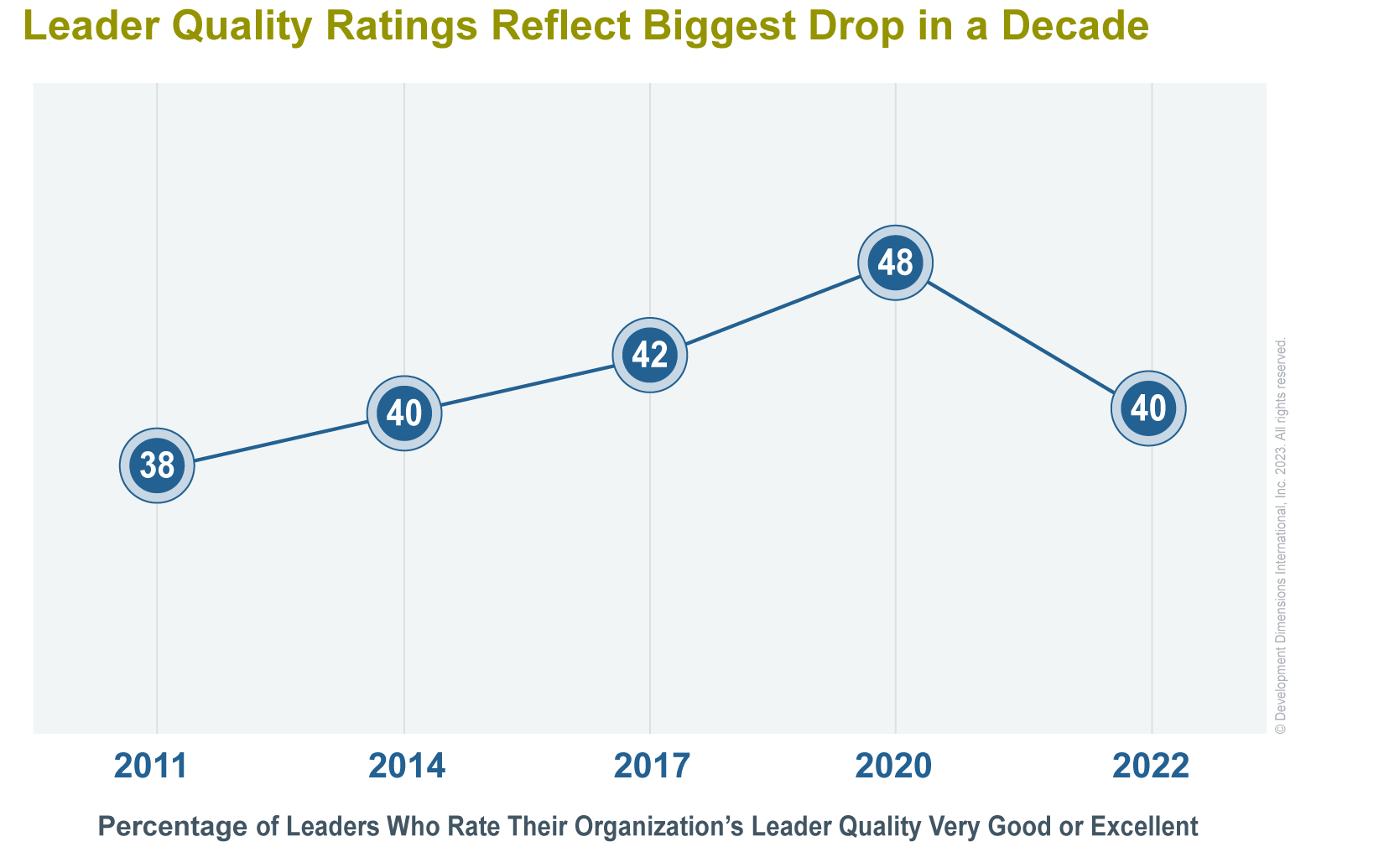
    A recent Report from DDI[A Leadership consulting firm] found that Only 40% of leaders reported their company to have high-quality leaders, reflecting the biggest drop in a decade.

    Enter the Fractional CXOs: Your Secret Weapon

    In today’s dynamic business landscape, Fractional CXOs (Chief Experience Officers) have emerged as a strategic asset for companies seeking top-tier executive talent without the full-time commitment. These seasoned professionals, including CEOs, CTOs, CMOs, CFOs, CHROs, and CPOs, bring invaluable expertise on a part-time or project basis. Let’s explore how Fractional CXOs can address your leadership challenges and propel your business forward:

    The Advantages of Fractional CXOs

    1. Cost-Effectiveness: Access top-tier leadership talent at a fraction of the cost of hiring full-time C-suite executives.
    2. Specialized Expertise: Benefit from executives with deep knowledge in specific areas, such as digital transformation or talent acquisition, to tackle critical challenges with proven strategies.
    3. Flexibility & Scalability: Engage Fractional CXOs for defined periods, ensuring perfect alignment with your project timeline or turnaround needs.

    Finding Your Ideal Fractional CXO: A Recipe for Success

    Building a dream team starts with the right leadership. But how do you navigate the world of Fractional CXOs and find the perfect fit for your business? Here are some key ingredients for a successful match:

    1. Know Your Needs: Before looking outward, look inward. Identify your specific challenges and growth goals. What expertise do you require—strategic guidance, financial acumen, technological leadership? Understanding your needs ensures you target Fractional CXOs who can bridge those gaps.
    2. Experience & Expertise: Track record matters. Look for Fractional CXO providers with a network of highly experienced professionals who have a proven record of success in your industry or with businesses facing similar challenges.
    3. Cultural Fit: Leadership goes beyond skills. Choose a Fractional CXO who meshes well with your company culture. Consider factors like leadership style, communication approach, and overall personality fit for seamless integration.
    4. Transparency & Flexibility: Reputable providers offer transparent fee structures and flexible engagement models. This ensures you understand the costs upfront and can tailor the Fractional CXO involvement—whether part-time, project-based, or ongoing—to your specific needs.

    How PSS Makes Your Fractional CXO Search Effortless (and Effective)

    Finding the perfect Fractional CXO can be a daunting task. At PSS, we take the guesswork out of your search with a tailored approach that prioritizes your success.

    • Expert Matching: Our rigorous vetting process ensures you connect with top-tier Fractional CXO talent who possess the proven experience and expertise to address your specific goals. We go beyond qualifications, taking the time to understand your unique company culture for a seamless integration.
    • Reduced Time to Hire: Our extensive network and streamlined process save you valuable time. We quickly identify and connect you with the ideal Fractional CXO who can make an immediate impact.
    • Proven Track Record: Leverage our experience working with Fortune 500 companies across various industries. We have a proven ability to deliver tailored solutions for businesses of all sizes.
    • Reduced Cost & Risk: Fractional CXOs offer a cost-effective and flexible alternative to hiring full-time executives, minimizing your financial risk.

    Stop Wasting Time on Your Fractional CXO Search! Schedule a free consultation with PSS today. Let’s discuss how we can help you find the perfect Fractional CXO to propel your business forward in 2024.

  • The Staffing Game Changer: Faster Hiring with On-Demand Talent

    The Staffing Game Changer: Faster Hiring with On-Demand Talent

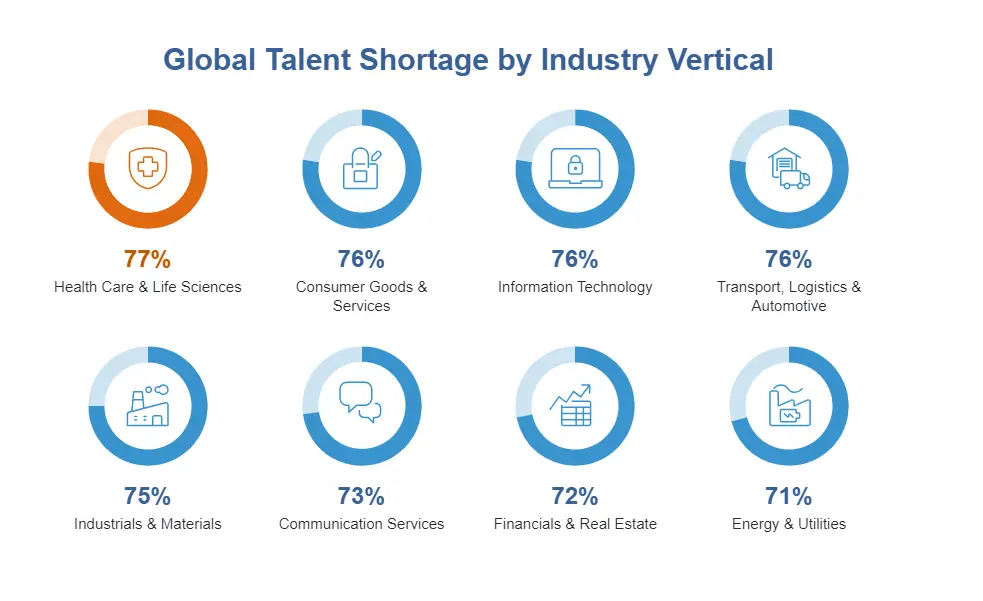
    The world of work is changing at an unprecedented pace. With the rise of the gig economy and remote work, businesses are facing new challenges in finding the right talent to drive their projects forward. In fact, a recent survey conducted by ManpowerGroup found that 75% of companies struggle to find the skills they need to succeed. This is where on-demand talent comes in—a revolutionary solution that allows businesses to build flexible, high-performing teams in record time.

    Source: Manpower Group

    What is PSS Consulting’s On-Demand Talent?

    On-demand talent is a revolutionary approach to staffing, offering businesses the flexibility to scale teams up or down as needed, with access to a global network of professionals. At PSS Consulting, we specialize in providing top-tier talent on your terms. From Fortune 500-caliber recruiters to a vast pool of active and passive candidates, we handle the entire recruitment cycle—from sourcing to payroll—so you can focus on what you do best.

    The Power of On-Demand Teams

    Building an on-demand team with PSS Consulting offers numerous benefits, including:

    • Faster Project Completion: Get the skills you need when you need them.
    • Reduced Overhead Costs: No more lengthy recruitment cycles or costly training programs.
    • Access to a Global Talent Pool: Tap into the best minds worldwide, not just freelancers but people with real-time experience.
    • Scalability to Meet Project Needs: Flex up or down as required. Freelance, contract or Fulltime

    PSS Consulting’s Expertise:

    We don’t just find talent; we build successful teams. Here’s how we can help:

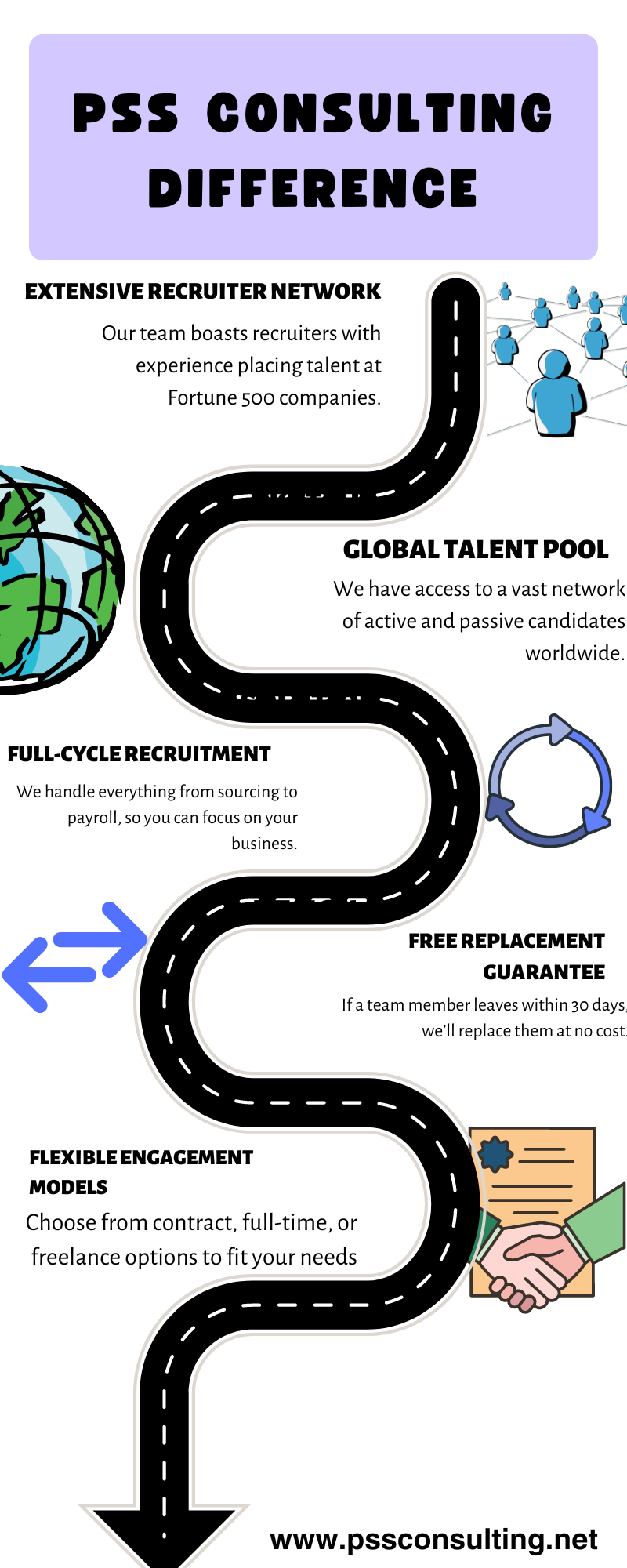
    • Extensive Recruiter Network: Our team boasts recruiters with experience placing talent at Fortune 500 companies.
    • Global Talent Pool: We have access to a vast network of active and passive candidates worldwide.
    • Full-Cycle Recruitment: We handle everything from sourcing to payroll, so you can focus on your business.
    • Free Replacement Guarantee: If a team member leaves within 30 days, we’ll replace them at no cost.
    • Flexible Engagement Models: Choose from contract, full-time, or freelance options to fit your needs.

    Looking Ahead: The Future of Work is On-Demand

    Are you ready to build your dream team, on-demand? Contact PSS Consulting today for a free consultation and discover how we can help you find the perfect talent for your next project.